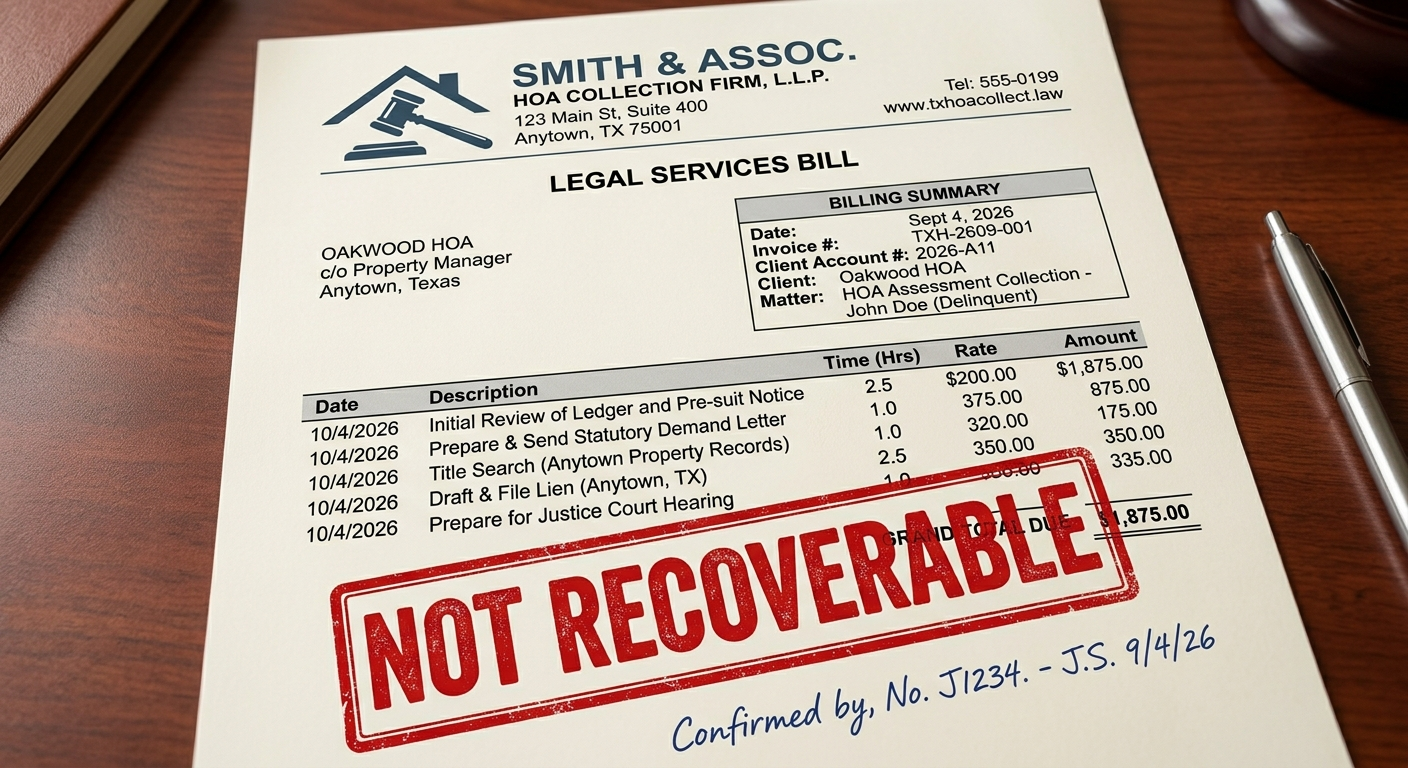
The Strategic Misconception
A lawyer’s blog circulating among Texas homeowners recently claimed that requesting a Sec. 209.007 hearing is futile. The argument: HOAs are not required to act legally; they can deny your claim even when you are legally correct; therefore a hearing is a losing battle no matter what you do.
That argument misunderstands what the hearing is for.
Whether the HOA grants or denies the hearing, whether it rules for the homeowner or against, whether the board behaves reasonably or punitively — none of that determines whether it can recover its attorney’s fees against you. What determines it is whether you requested a hearing and whether the HOA held one.
This is the most overlooked statutory protection in Texas HOA enforcement. It is not about winning the hearing. It is about triggering Texas Property Code Sec. 209.008(b) — and that subsection does most of the work for you.
What Sec. 209.008 Actually Says
Texas Property Code Sec. 209.008 governs HOA recovery of attorney’s fees. It has two operative subsections:
Sec. 209.008(a) — the precondition for fee recovery
A property owners’ association may collect reimbursement of reasonable attorney’s fees and other reasonable costs incurred by the association relating to collecting amounts, including damages, due the association for enforcing restrictions or the bylaws or rules of the association only if the owner is provided a written notice that attorney’s fees and costs will be charged to the owner if the delinquency or violation continues after a date certain.
To recover any attorney’s fees at all, the HOA must give the owner advance written notice that fees will be charged “if the delinquency or violation continues after a date certain.” This must be in the notice itself. An HOA that sues without first complying with Sec. 209.008(a) forfeits all of its fees.
Sec. 209.008(b) — the time bar
An owner is not liable for attorney’s fees incurred by the association relating to a matter described by the notice under Section 209.006 if the attorney’s fees are incurred before the conclusion of the hearing under Section 209.007 or, if the owner does not request a hearing under that section, before the date by which the owner must request a hearing. The owner’s presence is not required to hold a hearing under Section 209.007.
This is the rule most homeowners don’t know about. Read it carefully. An owner is not liable for attorney’s fees incurred:
- Before the conclusion of a Sec. 209.007 hearing (if the owner requested one), or
- Before the date by which the owner must request a hearing (if the owner did not request one)
Either way the result is the same: fees incurred before that point are not chargeable to the owner.
The structure is a clock. The clock starts running when the Sec. 209.006 notice is mailed. Fees incurred before the clock runs out are not recoverable. The clock stops for fees only when:
- The Sec. 209.007 hearing concludes (if one was requested), or
- The deadline to request a hearing passes (if one wasn’t)
Until one of those events happens, every dollar the HOA’s lawyers bill is potentially non-chargeable to the homeowner.
Two Cases That Confirm the Rule
Two Texas appellate decisions have interpreted Sec. 209.008(b) and given homeowners exactly the protection the statute provides.
Park v. Escalera Ranch Owners’ Ass’n, Inc. (Tex. App.—Austin 2015) — the Third Court of Appeals addressed a case in which the association had sued to enforce restrictive covenants without sending the required Sec. 209.006(c) pre-suit notice. The court’s upshot:
The association’s failure to comply with Sec. 209.006 was mandatory but not jurisdictional. A homeowner who fails to timely object or seek abatement can waive the notice defense. However, Chapter 209 limits the association’s attorney’s fees if it delays sending notice.
In other words, even when the homeowner waives the notice defect, the HOA’s fee recovery is restricted. The court did not eliminate the HOA’s claim — it eliminated much of its attorney’s fees.
Dao v. Mission Bend Homeowners Association, Inc. (Tex. App.—Houston [1st Dist.] 2022) — a First District Court of Appeals case reached an even stronger result. The association sent Dao a Sec. 209.006 notice about a fountain. Dao requested a Sec. 209.007 hearing. The association never held one. The association sued and obtained a judgment including substantial attorney’s fees. On appeal, the association conceded it had received Dao’s timely hearing request and had never conducted a hearing.
The court of appeals held:
Under these circumstances, the plain language of subsection (b) limits Dao’s liability for the Association’s attorney’s fees to those incurred after the conclusion of the requested hearing… Because the Association did not conduct a hearing on Dao’s fountain, all the attorney’s fees for which it sought reimbursement were incurred “before the conclusion” of a Section 209.007 hearing, meaning none are recoverable.
The court eliminated all the association’s attorney’s fees — not because the case was wrongly decided on the merits, but because the HOA failed in its procedural duty to hold the Sec. 209.007 hearing Dao had requested.
That is the rule in action. No hearing, no fees.
The Tactical Sequence
The sequence a homeowner should follow, and what each step triggers, looks like this:
Step 1 — Receive the Sec. 209.006 notice
The HOA sends a notice about the alleged violation. The notice should also include the Sec. 209.008(a) statement that attorney’s fees and costs will be charged if the violation continues after a date certain.
Step 2 — Request a Sec. 209.007 hearing
Under Sec. 209.006(b)(2)(B), the owner has 30 days from the date the notice was mailed to request a hearing. Do it in writing. Send by certified mail and keep the receipt. The request starts the Sec. 209.008(b) clock running.
Step 3 — The HOA must hold the hearing within 30 days
Sec. 209.007(c). If the HOA fails to hold the hearing within 30 days of the request, it is in violation of the statute, and Sec. 209.008(b) bars fee recovery until the hearing actually concludes. The HOA cannot make up for the missed hearing by holding one later — its default is its loss.
Step 4 — Maintain the Sec. 209.008(b) bar throughout the litigation
Until the hearing concludes, every attorney’s fee the HOA accrues is incurred “before the conclusion of the hearing” and therefore non-chargeable. If the matter proceeds to suit and the HOA still hasn’t held the hearing, fees remain barred.
Step 5 — At judgment (or in defense of it), invoke Sec. 209.008(b)
If the HOA sues and claims attorney’s fees, the homeowner moves to strike or eliminate those fees on the basis that they were incurred before the conclusion of a Sec. 209.007 hearing that was either: (a) never held, or (b) held only after the underlying litigation was already underway. Cite Dao and Sec. 209.008(b). The fees go away.
Why the Lawyer’s Blog Got It Wrong
The argument that requesting a hearing is futile because “the HOA doesn’t have to act legally” misunderstands what the hearing does:
- The hearing is not about who wins on the merits. It is about generating a fee-bar temporal window. Whether the HOA grants or denies the hearing, whether it rules for or against the homeowner — what matters is whether the hearing concludes and when.
- If the HOA denies the hearing, that itself is a violation. Sec. 209.007(c) plainly requires the HOA to hold the hearing within 30 days of the request. The board’s refusal to hold the hearing — whether explicit or constructive — is a statutory violation that activates the fee bar.
- If the HOA holds the hearing and rules against the homeowner, the hearing concludes and the fee clock ends. At that point, fees accrued after the hearing may be chargeable (subject to the reasonableness requirement). But everything before the hearing is preserved.
- If the HOA never holds the hearing at all, no fees are chargeable — for any work done before the hearing concludes. The Dao case made this explicit: all the attorney’s fees for which it sought reimbursement were incurred “before the conclusion” of a Section 209.007 hearing, meaning none are recoverable.
- The owner doesn’t even need to attend. Sec. 209.008(b) explicitly says “The owner’s presence is not required to hold a hearing under Section 209.007.” The HOA can hold the hearing without the owner, but it still has to hold one for fees to be chargeable after the fact.
The strategic posture, in short: request the hearing regardless of how confident you are in the merits, regardless of whether you think the HOA will hold one, regardless of whether you plan to attend. The request itself, and the HOA’s failure (if it fails) to hold the hearing, are what eliminate the fees.
What This Means in Practice
In practical dollars, Sec. 209.008(b) often works out to a substantial reduction of what the HOA can recover. Examples:
- A collection agency that bills for years without sending the Sec. 209.006 notice at all — all of those fees are non-chargeable.
- An HOA that sends the notice but never holds the hearing — all attorney work before the hearing concludes is non-chargeable.
- An HOA that holds the hearing late, after litigation has begun — attorney fees accrued before the late hearing are non-chargeable.
Even if the HOA wins the underlying case on every violation, the fee reduction is real money: thousands, tens of thousands, sometimes more, depending on how long the matter has been in litigation. And — critically — the fee reduction does not depend on the homeowner prevailing on the merits. Sec. 209.008(b) protects homeowners even when they lose.
What HOAs Do Wrong (and What to Look For)
The most common mistake HOAs make in this sequence:
They send a Sec. 209.006 notice, the owner requests a hearing, the HOA simply ignores the request, sends the matter to its attorney, sues, and wins — but does not realize that every attorney’s fee it just accrued is non-chargeable because no hearing was ever held.
A second common mistake: the HOA conducts the hearing after the suit is filed. By that point, fees have already accrued for months. The fee bar under Sec. 209.008(b) covers all that pre-hearing work.
A third common mistake: the HOA’s counsel writes the Sec. 209.006 letter without including the Sec. 209.008(a) “date certain” language. Without that language, no attorney’s fees are recoverable at all.
A fourth: the HOA’s board holds a “hearing” that doesn’t comply with Sec. 209.007(c)’s 30-day deadline, Sec. 209.007(f)’s packet requirement, or Sec. 209.007(h)’s procedure for the board to present its case first. A procedurally-defective hearing may not count as a valid Sec. 209.007 hearing for Sec. 209.008(b) purposes — though this is an evolving area of law.
Each of these is a separate basis on which a homeowner can move to strike or eliminate the HOA’s attorney’s fees after a judgment.
What Homeowners Should Do
If you receive a Sec. 209.006 notice from your HOA:
- Request a hearing in writing, immediately. Sec. 209.006(b)(2)(B) gives you 30 days from the date the notice was mailed to request a hearing. Don’t wait. Send the request by certified mail. Keep the receipt and the green card.
- Do not assume the hearing is futile. Even if you don’t think you can win, the hearing request triggers the Sec. 209.008(b) fee bar. That bar is worth real money.
- Demand the Sec. 209.007(f) packet. Under Sec. 209.007(f), the HOA must give you all documents, photographs, and communications it intends to introduce at the hearing, at least 10 days before the hearing. If they don’t, Sec. 209.007(g) gives you an automatic 15-day postponement. Use it.
- Document the date of every step. When the HOA mailed the Sec. 209.006 notice. When you requested the hearing. When the hearing should have been held. When the HOA didn’t respond. These dates drive Sec. 209.008(b)’s clock.
- If the HOA files suit without holding the hearing, invoke Sec. 209.008(b) in your answer. Plead the fee bar as an affirmative defense. Cite Dao. Cite Sec. 209.008(b). Ask the court to strike the HOA’s requested fees entirely.
- If the HOA obtains a judgment and the fees are included, file a motion to strike. Some courts don’t apply Sec. 209.008(b) on their own motion. It is the homeowner’s burden to raise it. Filing a post-judgment motion to strike the fees is the standard remedy.
- If the HOA does hold the hearing, attend or not — your choice. Sec. 209.008(b) makes clear that “the owner’s presence is not required.” You can attend to make a record. You can decline to attend and let the HOA proceed without you. Either way, the hearing has consequences for the fee clock.
The Bigger Point
Most discussions of HOA enforcement focus on who wins the merits. Did the homeowner actually commit the violation? Is the lien valid? Is the foreclosure proper?
This post is about something different: the protection that works even when you lose. Sec. 209.008(b) is a fee-recovery limit that applies regardless of the merits of the underlying dispute. It is triggered by procedural compliance — request the hearing, wait for the clock, and the HOA’s attorneys’ fees are wiped out.
The lawyer’s blog was right that the hearing itself is often futile. The lawyer’s blog was wrong about why that matters. The hearing is not the win condition. The hearing request is. Once you request the hearing, the HOA has to hold one for fees to accrue against you. And if it doesn’t — which it often won’t — the fees simply never become chargeable.
Sec. 209.008(b) is the most overlooked statutory protection in Texas HOA enforcement. It costs the homeowner nothing but a certified-mail letter. It can save thousands of dollars in fee awards. And it works.
This article is for informational purposes only and does not constitute legal advice. Statutes cited: Tex. Prop. Code §§ 209.006, 209.007, 209.008. Cases cited: Park v. Escalera Ranch Owners’ Ass’n, Inc. (Tex. App.—Austin 2015); Dao v. Mission Bend Homeowners Ass’n, Inc. (Tex. App.—Houston [1st Dist.] 2022). This article is the twelfth in a series on Texas HOA enforcement notices. Earlier parts addressed certified-mail delivery, defective collection notices, lien inflation, board-meeting notice issues, zombie fines, CARES Act payments, phantom amendment votes, inflated collection bills, unrecorded fine schedules, the strategic logic of sewer service, and Sec. 209.007(d)’s mediation substitute.